A second self · Coming 2026

Hello, you.

"Hello, you. I am the version of you that remembers…" Press play · ~20 seconds · in your AI's voice

Your inner monologue, finally written down. Speak each evening. Each morning, your life is read back to you — in your AI's voice, in your own context. You is the most private wiki you will ever own.

Six moments. One voice at your shoulder.

Where your AI shows up. Quietly.

Click a moment. Hear what your AI sounds like at the threshold of an actual decision — a hard talk, a hot reply, the call you've been avoiding, the late-night browser tab. Same voice. Different days. Always at the moment that matters.

Spoken by your AI

0:00 / 0:00
The idea

The thought layer is the asset.

In the AI age, the most valuable thing you carry won't be your résumé or your photos. It will be the texture of your inner life — what you thought, what you felt, what you keep coming back to. You records it. Organizes it. Gives it back.

I.

Speak.

Five minutes a day, by voice. No prompts, no structure, no journal-shaped guilt. Just talk about your day, your people, what's stuck in your head.

II.

Listen.

Each morning, your narrator reads yesterday back to you, and quietly tells you what to watch for today. Sixty seconds. In the voice you chose.

III.

Search yourself.

Six months in, the wiki of you is searchable, cross-referenced, and entirely yours. Your fears, your patterns, the people who matter — all linked.

The daily loop

One ritual. Three movements.

Keep it small enough to actually do every day. Keep it warm enough to want to.

9:30 PM

Evening — you ramble.

Open the app. Press record. Five minutes, voice only. Talk about whatever's loud in your head — the call that didn't go well, the joke your dad sent, the thing you almost said but didn't.

today my dad sent me that same forwarded video for the third time and I almost wrote back something cutting and then I didn't and now I'm thinking about why I almost did
OVERNIGHT

Overnight — the wiki grows.

While you sleep, your ramble is transcribed and structured into the wiki of you. New pages spin up. Existing pages get cross-referenced. Patterns surface — gently, in the margins.

linked to dad.md · 4th mention this month · pattern detected: you soften before responding to family — recurring
7:00 AM

Morning — you are read back to you.

Sixty seconds. Your narrator opens with "Hello, you." and tells you who you were yesterday — and what to watch for today. Spoken in the voice you cast.

Hello, you. You almost wrote something cutting last night, and didn't. That's the fourth time this month. Today, notice when the urge passes — that's the part worth remembering.
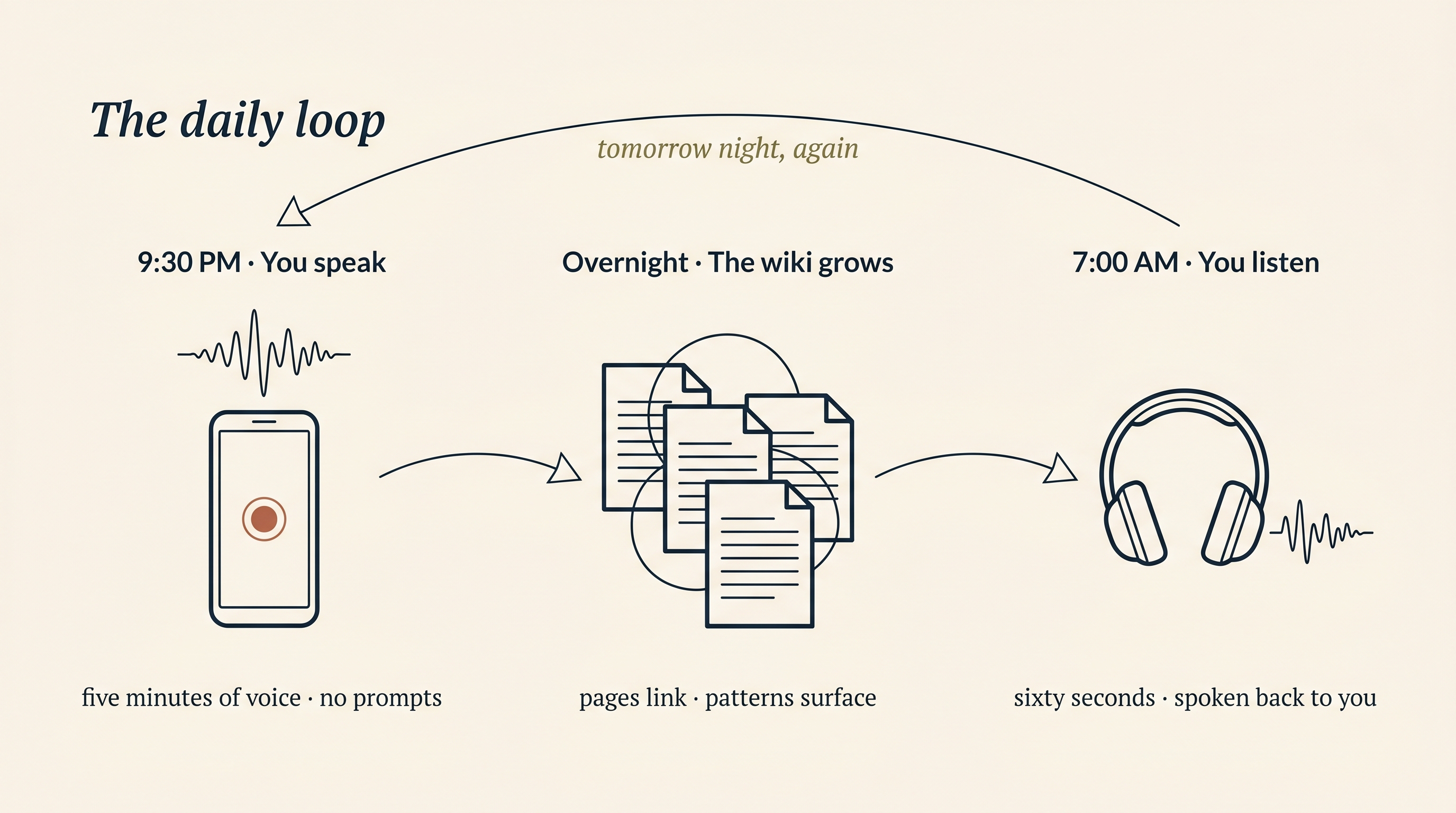
The daily loop diagram
Fig. 1 · The daily loop, in three movements.
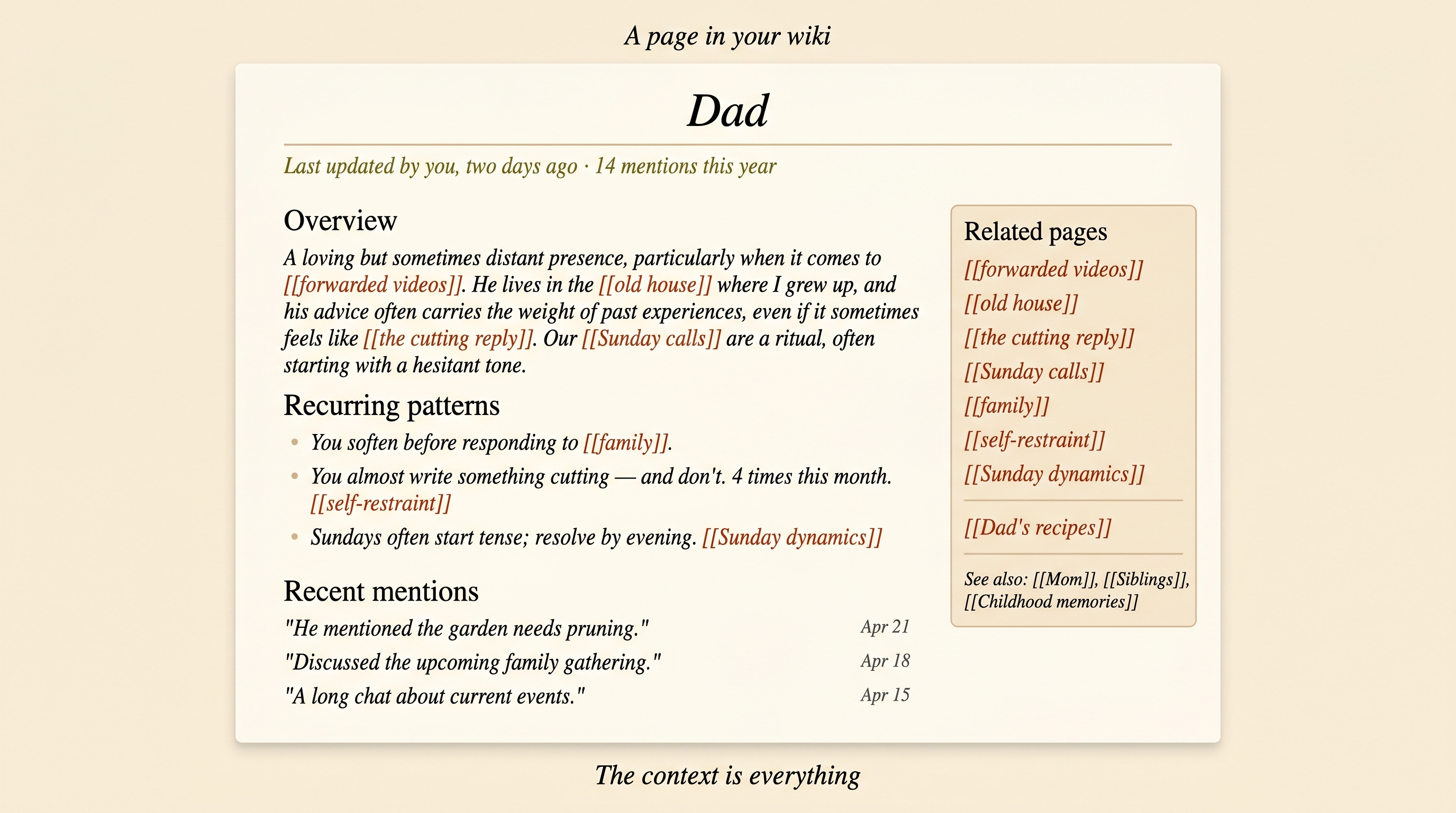
The wiki of you

What is a wiki, exactly?

Think Wikipedia — but the encyclopedia is about you. Every person, place, mood, project, and recurring theme in your life gets its own page. The pages link to each other. They update automatically as you talk. You are the only reader.

A single page in your wiki — auto-updated every time you mention him
Fig. 2 · A single page in your wiki — written by you, indexed for you, read only by you.

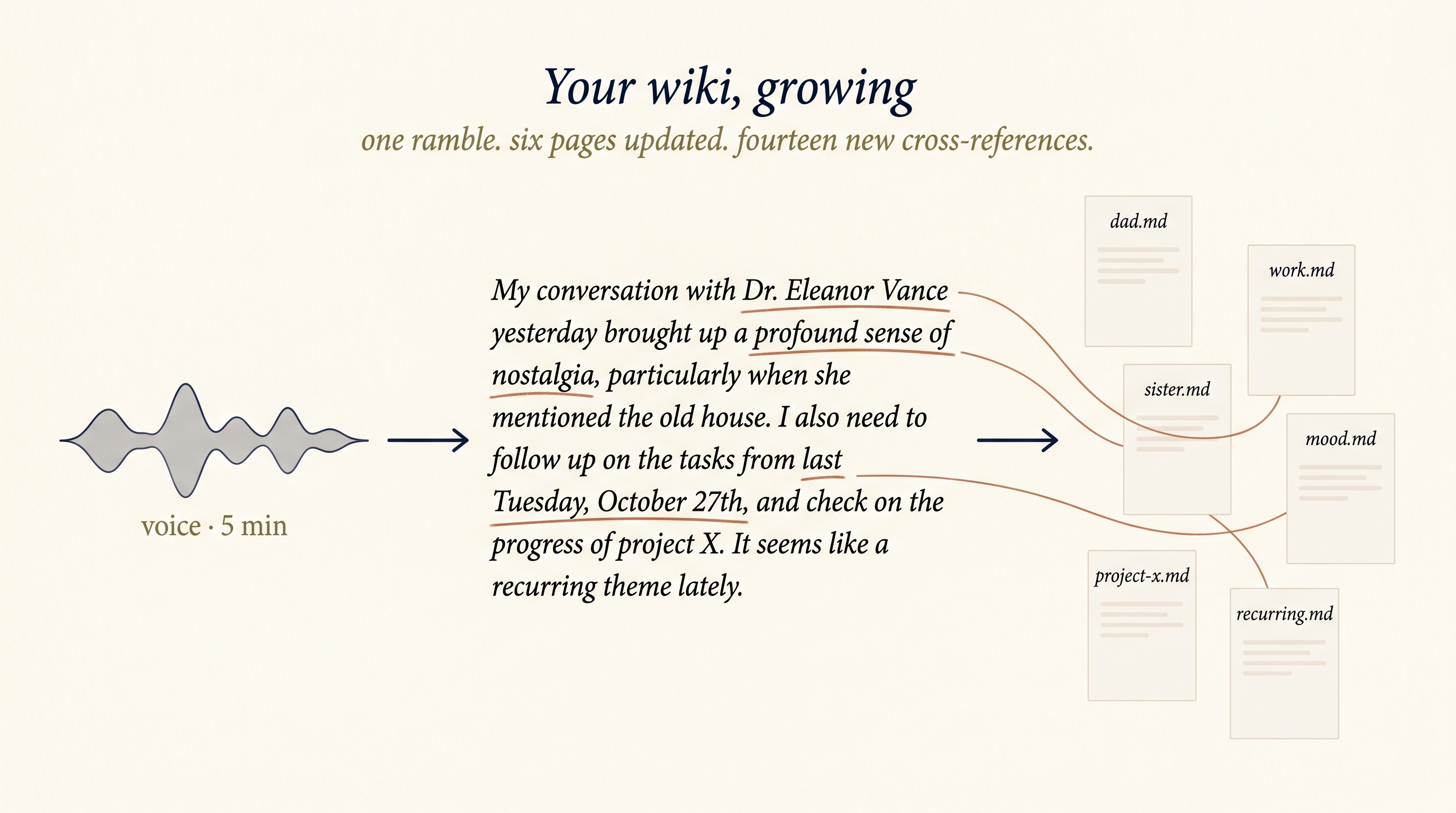
Five minutes of voice.
Six pages updated.

Every ramble becomes structure. Pages for the people who matter, the moods that recur, the projects you keep avoiding. All linked, all yours, all in plain markdown.

One night, your wiki gains:

A new page for the friend you just met. A small update to dad.md, where the same pattern keeps surfacing. A cross-reference between work.md and boundaries.md. A mood note that quietly links to the same one from last March.

By month two, you stop asking "why do I keep feeling this?" — your wiki tells you, with citations.

📄 dad.md · 4 mentions
📄 sister.md · new entry
📄 work.md · linked to boundaries
📄 mood-tuesday.md · recurring
📄 project-x.md · 12 day silence
📄 the-email.md · 3rd draft
Voice transcribed into linked markdown pages
Fig. 3 · One ramble. Six pages. Fourteen new links.
What you'd actually use it for

Six small reasons to talk to it tonight.

Concrete moments where You earns its place. Pick the ones that feel like yours.

After a hard day

Ramble it out. Wake up to a kinder version.

Five minutes of unloading at 11pm. By 7am, your narrator gives you back the same day — softer, sorted, with the one thing actually worth remembering pulled to the front.

You said three hard things last night. Only one of them was true.
When you can't tell what's bothering you

Search your own patterns.

"What's been on my mind this month?" — answered by your wiki, with citations to the rambles that surfaced it. Self-knowledge that doesn't need a therapist's prompt.

Mentioned the new role 11 times. Mentioned sleep 14. The two are linked.
Before therapy

Bring real evidence, not vibes.

Most therapy hours start with "so… how was your week?" Show up with a real answer. The wiki holds the patterns; you walk in already focused.

Three Tuesdays this month, same pattern. Today we'll talk about that.
As a companion

The one who actually remembers.

Talk to your You like you would a quiet friend. It already knows your sister's name, the project you're avoiding, the line you said three weeks ago. Nothing to re-explain.

You haven't mentioned mum in twelve days. Want to talk about that?
When connecting other AI

Give every AI the real context.

One-click consent: let your assistant, your therapy bot, your music agent read what you choose to share. They'll stop suggesting things you've already rejected.

Your assistant now knows you don't take meetings on Mondays. You wrote that, twice.
For the long arc

An estate of the soul.

Your wiki is exportable, encrypted, and durable. Pass it on. Or don't. But the thought layer of you — the one that vanishes when you do — stays, in your own voice, if you let it.

A grandchild asks: what was she like, on a Tuesday? The wiki answers.
Your narrator

One voice. Carefully chosen.

Warm, hushed, knowing — the closest thing to the inner monologue of You. The same voice every morning, for as long as you keep listening.

"Hello, you."
Tonewarm · hushed · just-knowing Paceslow, steady · lets the silences sit Dictionconversational, mid-Atlantic American VoiceStudio-synthesised · cast for tone Referencethe inner narration of You (Netflix)

The voice you'll wake up to was chosen carefully. We auditioned six narrators — sharp, lyrical, breathy, sage — and listened to each one read the same morning a hundred times.

Only one was right: a warm, hushed, knowing voice that doesn't lecture, doesn't diagnose, and doesn't pretend to be a coach. It speaks to you the way a quiet friend who has been paying attention all year would speak. The way the inner monologue does, when it's being kind.

It is not your voice. It is the voice that listens for you, and gives the day back to you in shape. Hello, you.

Why it matters

You are forgetting yourself.

Most of who you were this year is already gone. You is the quiet substrate that holds it.

i.

Memory is fragile.

You'll forget 99% of what you felt this week. Not the highlights — the small things. The mood on a Tuesday. The thing your friend said that made you reconsider. You keeps it, so when you need to find yourself again, the trail is there.

ii.

Every AI you'll use deserves to know who you actually are.

The next decade of AI products will all need context about you — your taste, your values, your shape. You is the substrate. You own it. You decide what to share, and with which agent.

iii.

The thought layer outlives you.

Your photos survive. Your texts survive. But the texture of how you thought — that vanishes the day you do, unless someone wrote it down. You is that someone. Quietly, for years, in your own voice.

The promise

Only you should read this.

The whole product dies if anyone but you can read your wiki. Privacy isn't a feature here. It's the entire foundation.

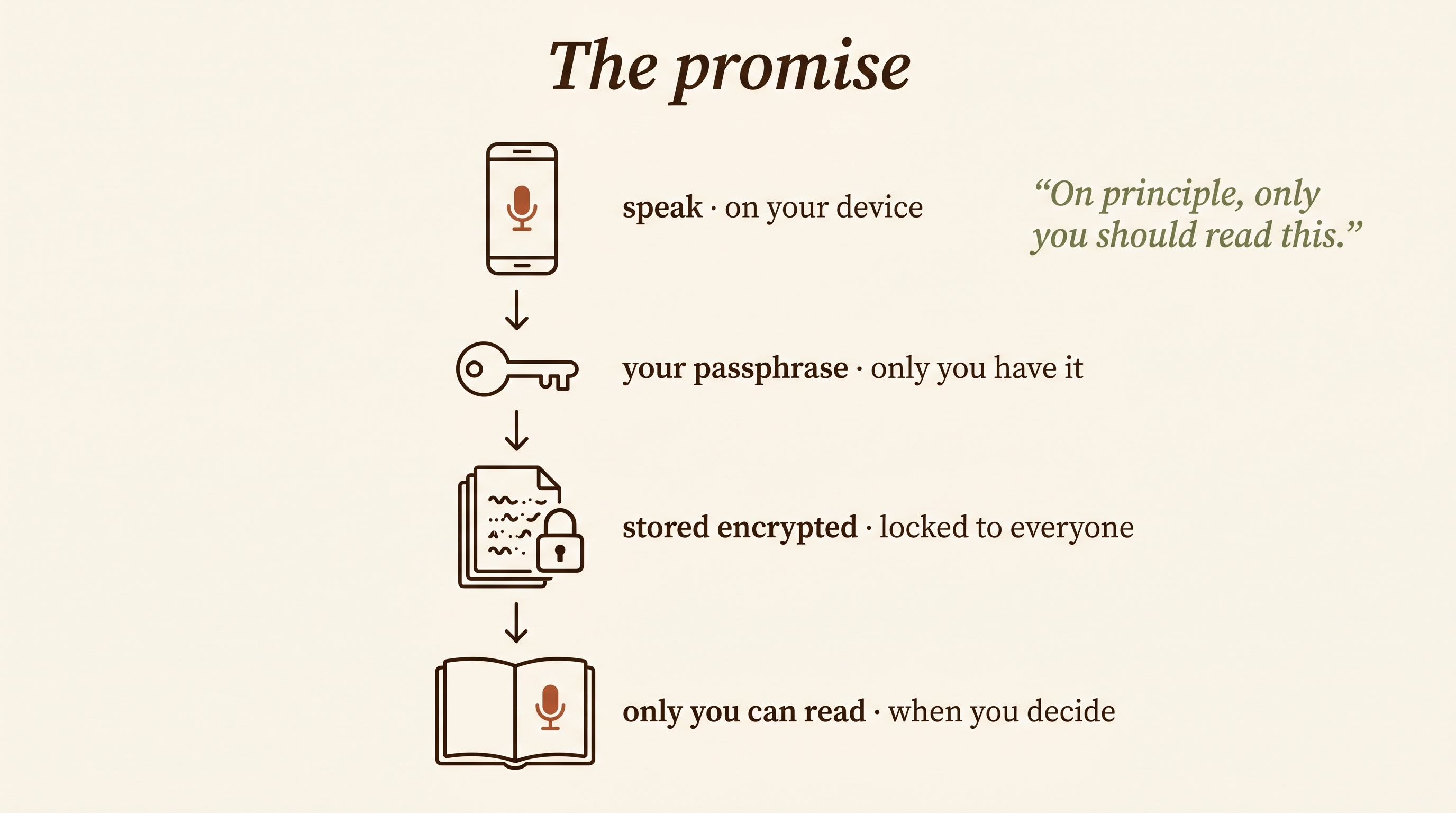
End-to-end encrypted.

Your passphrase is the key. We store ciphertext only. We can't read your wiki even if we wanted to. Even if we were forced to.

Local-first.

Your data lives on your device. Sync is encrypted. Voice is transcribed in a zero-retention enclave. Nothing is logged. Nothing is trained on.

Yours forever.

One-tap export to plain markdown. Take your wiki and walk. We are not a moat — we are the librarian. Your library is yours.

Privacy architecture: speak, encrypt, store ciphertext, export markdown
Fig. 4 · From spoken word to your own ciphertext, by way of a passphrase only you have.
The first listeners

Be heard, first.

We're inviting a small first group in 2026. Leave your email — we'll send you a quiet note when it's your turn, with the voice you chose already cast.

No marketing. One email when it's ready. Nothing else.